


Artchive
An Edutainment System for Children's Creativity Development
Background
My experience as a teacher in a children's art school in Beijing in 2019 inspired this project. I found some problems in the children's art education industry that contradicted the pedagogical theories I had learned, so I wanted to create a digital product to improve this situation.
Skills
User research, usability testing, UI design, illustration, game design, heuristic evaluation
Form
Tablet application using digital pen
Problems & Solutions
Problems Identified | Solutions Provided |
|---|---|
Limited Engagement 58% of observed students couldn't maintain focus; many lost patience during drawing | Interactive Storytelling Gamified learning through interactive picture books with three phases: creativity training, problem-solving, and 3D perception |
Dependency & Mimicry Students often copy finished works or rely heavily on teacher intervention | Adaptive Support System Provides contextual hints and reference photos instead of finished drawings; uses audio cues to maintain engagement |
Assessment Difficulties Parents struggle to evaluate progress; traditional scoring creates unhealthy competition | ML-Based Assessment Evaluates drawing ability using machine learning; tracks progress through quantitative metrics while avoiding numerical scoring |
Market Context
Education ranked first in the 2020 list of consumption of Chinese parents
24.8% of the parents want their children to join a drawing class.
The consumption intention of education was on the rise


Source: China Central Television
Field Studies
Interviews in Children's Art Schools
Parents are saying...
“I don’t know how to evaluate my kid’s paintings.”
“I sometimes help her draw some objects but she seems to depend too much on me for help after that.”
Teachers are saying...
“Sometimes I feel like many students just can’t concentrate on drawing.”
“The courses have to be engaging.”
Observation of Drawing Classes

Some students copied the finished paintings without creativity of their own.
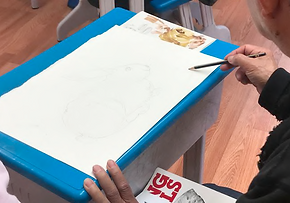
Some teachers directly helped students draw instead of telling them why and how.
Distraction
7 out of 12 kids had difficulty concentrating all the time.
Uncertainty
3 of them felt not sure what they shoul do next and want others to help.

Uncertainty
5 of them lost patience and felt that they can’t keep drawing during the process.
Anxiety
2 of them felt anxious or jealous when their classmates did better job or finished faster.
Literature Review
According to Your Child and His Art: A Guide for Parents by Viktor Lowenfeld, a book about children's art education, here are some insights that are important to address the problems found in field research.
Do's and Don't's for Adults
Do's | Don't's |
|---|---|
See children's creations as a part of their growth | Don't impose your own idea to children |
Ensure children's sensitivity to the surrounding environment | Don't let them see how other people draw before they start drawing |
Encourage children to appreciate each other | Don't compare their works |
Understand Children's Stages of Artistic Development
By understanding Lowenfeld's stages of artistic development theory, educators can better understand children's drawing abilities and track their progress

Portfolio Assessment
Portfolio assessment is an alternative method of evaluating students' learning and performance that involves the systematic collection and analysis of a student's work and accomplishments over a period of time. It goes beyond traditional testing by providing a comprehensive view of a student's abilities, growth, and achievements.
Journey Map

Concept

Information Architecture

Wireframes

Final Design
Difficulty Customization
Based on Lowenfeld's theory, use machine learning to customize the difficulty according to the user's ability.

"Draw a picture of yourself"


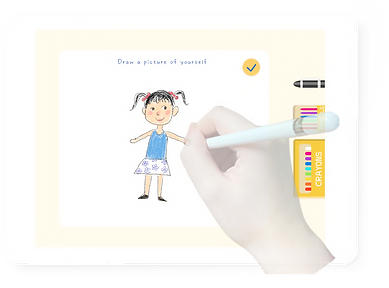
Choose a recommended theme


Friend Matching
Match online or invite a friend. The collaboration feature will give children more motivation and learn to appreciate each other.


Creativity Training
This activity lets users draw freely, often decoratively, anything they like. Then, the drawn picture will appear and integrate with the picture book. This is a warm-up task for them to familiarize themselves with the application.
"Draw something to decorate the hall"


Story Telling
The story-telling session will happen in between different tasks to reduce the workload and make the learning process more entertaining.
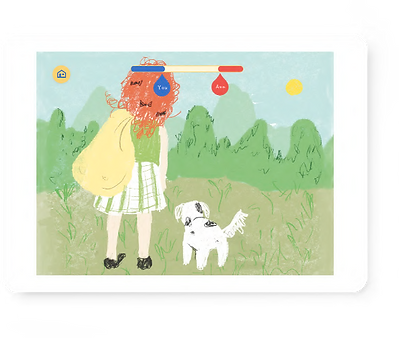
This section allows children to draw something that can be a part of the story and make an impact. AI will detect what the user draws and integrate the image into the original picture book.


Problem Solving Training
"Oops, why do you stop drawing? Do you need any help?"
Help System
After one minute without operation, the system will send an audio message to avoid distraction.
Users can also choose to get a hint through the pop-up window.

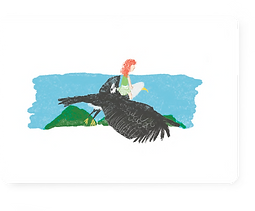
Story Participation
The picture the user just drew would be part of the book, making the gamified learning experience more engaging.
3D Perception Training
According to the literature review, 3D perception is a challenging part of children's development. A big part of making art is also to observe the real life. To build a foundation for feeling the 3D world and to connect the screen to real life, I designed an AR learning section for children to put their drawings in real life.

The AR game is triggered after both players finish their progress bars

Hold the iPad and scan a flat platform to start drawing in AR mode


Click the arrow to change the viewing angle
Pinch/open to zoom in/out
Finish the game and get awarded


Evaluation
According to the interviews, parents have trouble tracing their kids' progress. Here, I visualize what the kid has accomplished. It also encourages the kids more by giving them rewards and a sense of achievement rather than judging and criticizing.
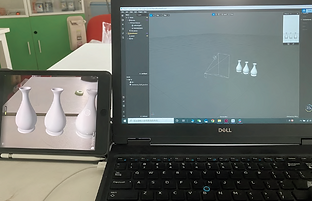
Making a demo with Spark AR


Testing the demo with children

Heuristic evaluation
Human-Machine Interaction Test
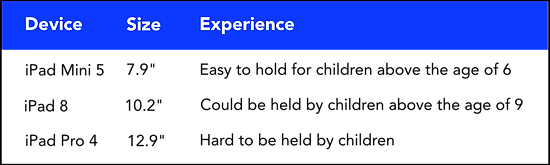
Heuristic Evaluation

The project grew out of my time teaching art, and it taught me that engagement comes from understanding how learners feel at each step. It’s the approach I bring to everything I design: research, then storytelling, then testing with real learners.
In hindsight, the UI could be more polished. It leans childish, doesn’t follow UI design principles closely enough, and the orange background lacks contrast. I’d revisit it with a lighter palette that meets WCAG contrast standards and a more consistent layout.